THE PEASANT, THE PROSTITUTE, THE RIOT AND THE DOME
It’s 532 AD in Constantinople, the capital of the Roman Empire. Centuries later to be the heart of the Byzantine Empire, on this day the city and its residents are Romans to the core. The city of Rome itself and much of the west may have withered from the imperial vine, but the Empire is thriving and fruitful in the East.
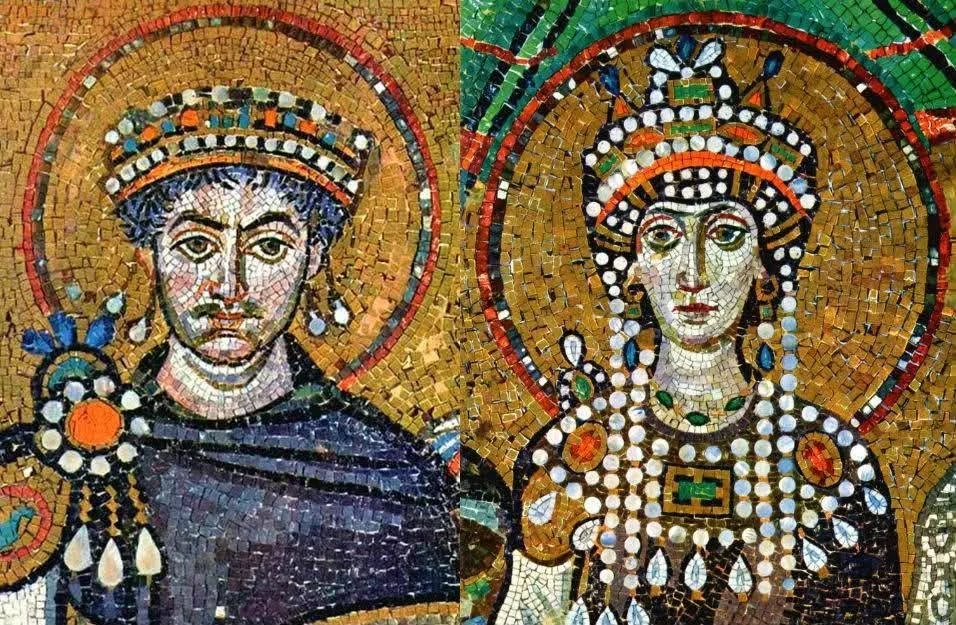
Emperor Justinian and his wife, Empress Theodora. Detail of mosaic in Ravenna, Italy. Yanked from the internet. Absolutely no rights reserved.
On this brisk January day the emperor Justinian has a problem. Born a peasant, he clawed and connived his way to the top, all while enduring the scorn of those who mocked his lack of aristocratic credentials. However, that humble background could help him with today’s dilemma: disgruntled sports fans.
Chariot races have always been more popular than gladiator contests, which, with Christianity ascendant, have largely ceased. By contrast, the chariot races are the lifeblood of the city. Their popularity is only exceeded by, at least on some days, zeal for the Holy Trinity. Justinian is a professed fan of the races, having followed them since his youth. In fact, he roots for the Blues.
As it’s been for centuries, the Greens challenge the Blues for supremacy and rich rewards. Here in the Hippodrome, the fans of these two teams are legion and frequently fight. A recent brawl got so bad that a few fans were sentenced to hang for their part in the melee.
On execution day, however, the gallows were uncooperative. Two of the convicted, a Green and a Blue, were spared when their nooses broke. After they thudded to the ground, the executioners again tied the nooses and again, the nooses failed. Before a third attempt, local monks hurried the two men away to sanctuary. Religious sanctuary was a temporary pardon, at best, though. Imperial forces simply blocked the exits and starved out those who deigned to escape their lawful punishment.
Against this background, 100,000 fans are setting their rivalries aside and speaking with one tendentious voice that implores Justinian to set the condemned men free. God Himself surely demands their survival, having twice delivered them from death. A word or even a gesture from the emperor, ensconced in his viewing box in the Hippodrome, would halt the executions and be richly rewarded by the gratitude of the teeming masses. Justinian says and does nothing, though. His message is clear. Justice will be served. The prisoners will hang and hang and hang again until their sentences are carried out. And so they would be.
The Greens and the Blues do not take this outcome well. In high dudgeon, they stream out of the stadium and begin laying waste to Constantinople. As they rampage, they yell “nika, nika!”, confident that by declaring “victory, victory!” they will secure the release of their comrades.
This is the Nika Revolt. By week’s end the rioters’ fires and rampages will have destroyed fully a third of Constantinople - already a huge city - and cause much loss of life. While the fate of the convicted men is the catalyst, there’s much more at stake. Taxes are high, corruption is rife, and the government burdens the people in other innumerable ways. Those same people want heads to roll. The emperor’s forces have so far refused to counter the revolts out of reluctance to attack their fellow citizens.
Amid the chaos, Justinian and his advisors retreat to the security of the royal palace. Over the next few days, fear fills them as they consider responses both grim and few. Justinian and his council decide that he must leave the city to preserve his life, if not his rule.
But Theodora has a different idea. As a former practitioner of that most scandalous profession - acting - she had been held in little higher regard than a slave when she began her courtship with Justinian. Because success as an actor required prostitution, her past was indeed sordid. But the couple’s love overcame the scorn of the world and they were wed. She became Empress of the Roman Empire.
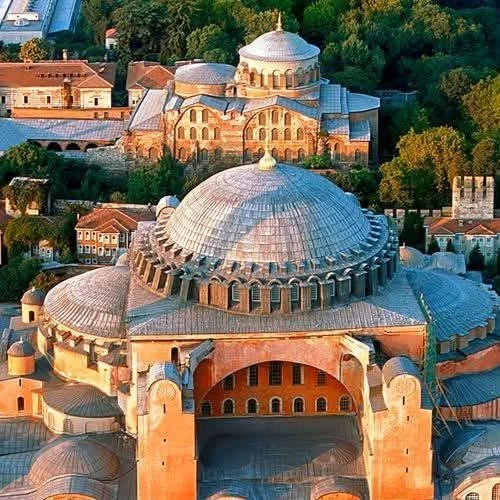
The Hagia Sofia. This photo .. um .. followed me home from the internet. Yeah. I don’t know who its owner is.
Theodora is always redoubtable and on this day her resolve exceeds her husband’s. She scoffs at the notion of fleeing. If death should be our fate, she exhorts, at least royal purple makes a fine burial shroud. Better then to stay and fight.
Convinced, the royal council hatches a plan. Appearing to go about business as usual, they announce a new round of chariot races. As expected, the Hippodrome fills with agitated fans. As the situation again begins to spiral out of control, the emperor’s forces block the exits and begin pouring in, weapons brandished. Their slaughter of unarmed fans is indiscriminate and merciless. By the time it’s over, 30,000 residents of Constantinople lay dead. The Nika Revolt thus ends more brutally than it had begun.
Justinian will soon deal with the aftermath of his smoldering city. He’ll embark on a bold rebuilding project. Amid his laments, he mourns the loss of the Hagia Sophia - the Church of Holy Wisdom. Its reconstruction will become a priority. He envisions a dome for the Hagia (HIGH-uh), one that will be the largest in Christendom. The price tag is steep: 320,000 pounds of gold. That’s $22.5 billion in today dollars. Note the ‘b.’
But the Hagia Sophia will rise again to become the jewel of Christendom. It will remain the largest dome in the world for nearly a millennium until the dome of St. Peter’s Basilica at the Vatican surpasses it.
The loss of life in the Nika Revolt was deeply regrettable, of course, but God was forgiving. The city would return His favor with the Hagia Sophia, and regard it worthy of every ounce of gold. In a very real way, after due deference is paid to God and the city’s treasury, we will have a former prostitute to thank for a monumental accomplishment that stands to this day.